

Article
Zaha Hassan, Charles H. Johnson
{
  "authors": [
    "Zaha Hassan"
  ],
  "type": "commentary",
  "blog": "Diwan",
  "centerAffiliationAll": "",
  "centers": [
    "Carnegie Endowment for International Peace",
    "Malcolm H. Kerr Carnegie Middle East Center"
  ],
  "englishNewsletterAll": "",
  "nonEnglishNewsletterAll": "",
  "primaryCenter": "Malcolm H. Kerr Carnegie Middle East Center",
  "programAffiliation": "",
  "regions": [
    "United States"
  ]
}
Source: Getty
What is behind Marco Rubio’s announcement that the body is now an international nongovernmental organization?
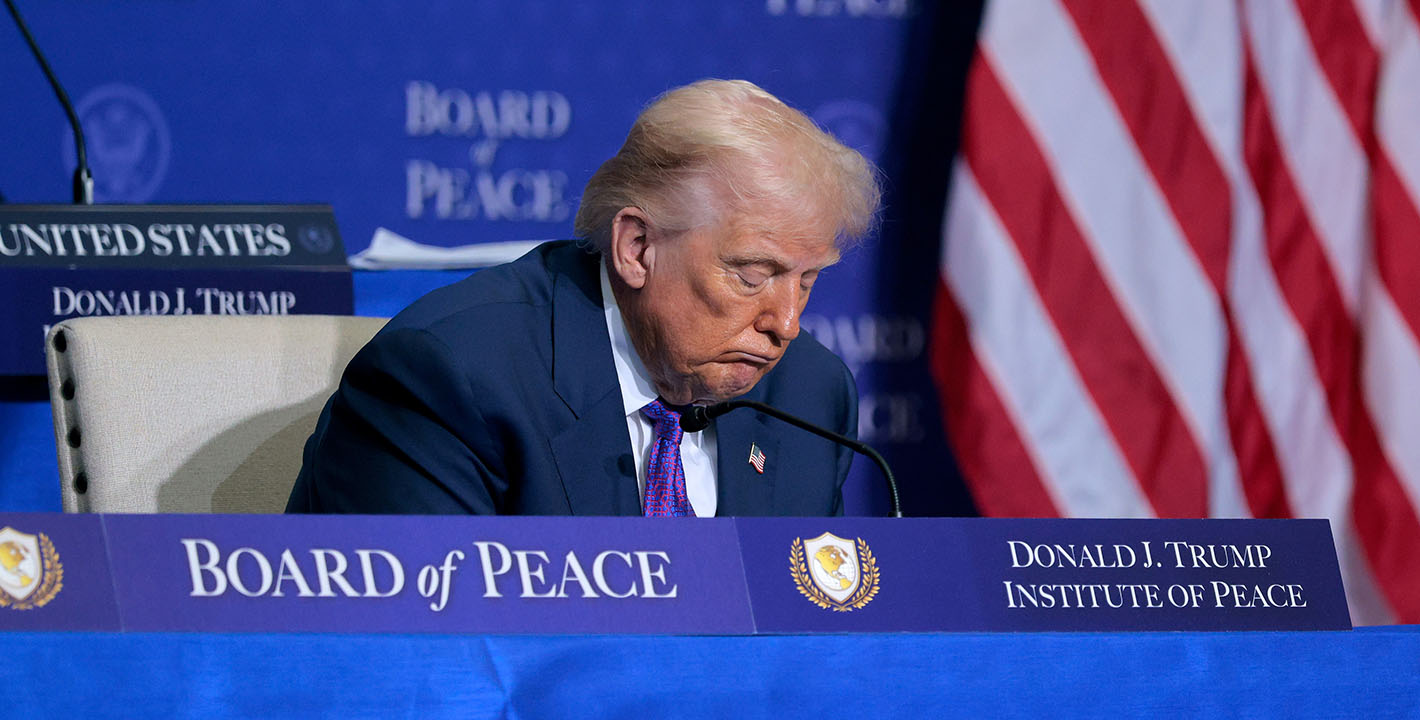
U.S. Secretary of State Marco Rubio casually dropped what should have been viewed as a bombshell during his testimony before the Senate Foreign Relations Committee recently. Rubio declared that the Trump administration had decided to transform the Board of Peace—the body President Donald Trump established to purportedly end the war on Gaza—from a public international organization made up of member states (akin to the United Nations) into an international nongovernmental organization (INGO). This metamorphosis comes less than six months after Trump established the board by Executive Order 14375 and strongly encouraged Gulf Arab states to sign its charter. In this way, they would become founding members, and if they paid $1 billion dollars secure a permanent seat.
Before the change, the Board of Peace was already on shaky ground. The UN had never before given its imprimatur to what would become a multilateral body in which state parties were not co-equals and where the leader of one state designated himself chairman for life. These were in addition to concerns about the board’s mandate that excluded Palestinian participation in governance structures and left no timeline for when responsibility in Gaza would be transferred to the Palestinian Authority.
Though some states joined the Board of Peace for the status of being in Trump’s political orbit, its transformation into an INGO after the UN Security Council endorsed it as a multilateral governing body is more than just poor diplomatic form. Many states, including those on the Security Council, decided to endorse the initiative despite their many reservations. They did so because they believed that under Trump’s leadership U.S. leverage would be deployed to compel Israel to end the war on Gaza and allow humanitarian relief to enter the enclave unrestricted.
Regional stakeholders and the Palestinian Authority also took some comfort in the fact that, because institutions like the World Bank and the UN had endorsed the board, guardrails would be set up to ensure the body would be compliant with legal obligations and manage funds transparently according to international best practice.
Rubio’s latest revelations about the board, however, upend these hopes and expectations. If converting the board’s legal status aims to avoid U.S. congressional oversight and keep much of its activity opaque, then this alone should be enough to raise alarm bells among lawmakers and UN Security Council members about the Board of Peace and how it will execute its mandate.
Trump’s intention in creating the Board of Peace was evidenced in Executive Order 14375 in which he designated the board “a public international organization.” Similarly, the board’s charter provides that it and its subsidiary entities will “possess international legal personality… and shall ensure the provision of such privileges and immunities as are necessary for the exercise of [their] functions…” Before his latest testimony, Rubio confirmed to members of the Senate what this meant: the board would have the same legal status as the UN. And as required by law, in March the State Department notified Congress that the “United States of America signed the Charter of the Board of Peace.”
Despite this clear intention that the board would be established as a multilateral organization, Rubio, without explanation, made his announcement to the Foreign Relations Committee. A number of U.S. senators and members of Congress have been raising questions about the board’s structure and lack of transparency and accountability (see, for example, here and here and here), particularly given Trump’s absolute control over decisionmaking and management of the billions of dollars in pledged contributions.
Rubio asserted during the committee hearing that Congress has oversight responsibilities only over the $10 billion of U.S. taxpayer dollars pledged to the board, none of which have been transferred to date. This means the administration does not intend to seek congressional authorization for U.S. participation in the Board of Peace or secure Senate ratification of the board’s charter as a U.S. treaty. It also suggests the administration believes that, as an INGO, the Board of Peace would not be subject to congressional oversight in the future over the $7 billion in contributions pledged by Arab Gulf states or other foreign governments.
When Rubio was asked how much money was in Board of Peace accounts, he responded that since no U.S. taxpayer money had been deposited yet, he couldn’t give Congress a number. Thus far, the pledges of support made at the board’s inaugural meeting in February have not been fulfilled and the multilateral donor World Bank account, established to manage board funds before any monies are transferred to implement projects, remains empty. Money received from stakeholders, such as the combined $23 million from Morocco and the United Arab Emirates, are to be held in a private account at J.P. Morgan Chase, over which Rubio believes Congress has no oversight responsibility. The administration has not provided information on the board’s website pertaining to the accounting practices or management of its funds held in private accounts, keeping lawmakers in the dark.
Though Rubio believes Congress has no oversight over accounts holding non-U.S. contributions, this may not be entirely accurate. To the extent U.S. money is commingled with foreign contributions, Congress will have some ability to review the management of the funds. But even if funds are not commingled, the fact that Trump is acting in his personal capacity as chairman of the Board of Peace and retains ultimate authority over any of the board’s private bank accounts, triggers the Foreign Emoluments Clause. This constitutionally based requirement aims to prevent corruption and foreign influence over federal officials, including the president, by requiring congressional consent before federal office holders may receive payments from foreign governments. Congressional consent will be required each and every time a foreign government intends to transfer money to the board so long as Trump or one of his assignees have control over the account during the president’s term in office. Even funds in the World Bank account associated with the board may be subject to congressional oversight if those funds are to be transferred later directly to the Board of Peace.
Thus, lawmakers have a right and responsibility to interrogate contributions before transfers are made to bank accounts over which the president has control. In fact, congressional concern should be heightened given that Trump could hold the position of chairman of the Board of Peace—and control over associated bank accounts—beyond the term of his office.
When members of the UN Security Council voted in favor of endorsing Trump’s Comprehensive Plan to End the Gaza Conflict (the Trump Plan) and the Board of Peace in Resolution 2803, they did so with some trepidation due to the plan’s vague terms and lack of a timetable associated with its phases that would culminate in a political horizon for Palestinians. Members also did not have the benefit of reviewing the Board of Peace’s charter to ensure its structure and legal status would conform to international standards and practice, and that mechanisms for oversight and accountability existed.
Despite these concerns, they endorsed the Trump Plan and its Board of Peace in the hope that Palestinians in Gaza would see an end to Israeli bombardment and civilian deaths. The two-year sunset of the Board of Peace mandate and the regular reporting requirement also offered some comfort that, should the board prove to be ill-suited for the mission at hand or if the worst fears about what it could become were confirmed, Security Council paralysis (due to U.S. veto power) would not keep it veiled indefinitely in the legitimacy of a Security Council endorsement.
Now that Rubio has made the surprise announcement that the board is no longer a multilateral organization, any pretense that states might have had that the body would responsibly govern Gaza for a transitional period for the benefit of Palestinians is no longer possible. Security Council Resolution 2803 and the board’s charter warranted that it would have international legal personality and be subject to international law as a multilateral organization. While calling the Board of Peace an INGO may better conform to the board’s actual structure, which gives Trump ultimate decisionmaking authority, including over financial matters, it also confirms the lack of power states will have to steer the board and to mitigate the Trump administration’s worst impulses. And despite the sunset clause in the Security Council resolution, the board’s charter envisions that it will endure beyond the expiry date of the council’s endorsement—as will Trump’s stewardship over it. And given how interlinked the Board of Peace is with the government of Israel (as one example, a member of the Trump-appointed Gaza Executive Board is also Israel’s appointed representative in the U.S.-led Civil Military Coordination Center tasked with humanitarian relief in Gaza), it cannot be entrusted to alleviate Palestinian suffering.
Security Council members should force a vote calling for the withdrawal of the council’s endorsement. If the United States vetoes the resolution, as is likely, council members should sign a collective statement supporting a withdrawal of states from the Board of Peace and indicating their endorsement of existing mechanisms to support Gaza relief and reconstruction and Palestinian self-determination. Failing to do so while states make good on their financial commitments to the board increases the likelihood of Palestinian forced displacement by enabling Israel to take material steps toward achieving this end.
States need only review the board’s track record to date. According to a jointly released humanitarian scorecard in April 2026, “[S]ix months on from the signing of the ceasefire plan, implementation… is regrettably failing. In particular, Palestinians are continuing to suffer extreme deprivation, hunger, injury, and death due to the Israeli government’s continued attacks, movement restrictions, and aid obstructions.” Nearly 1,000 Palestinians have been killed in Gaza since the start of the so-called ceasefire and Palestinian doctors remain in Israeli prisons without charge—prisons where credible evidence of torture exists. Israel continues to restrict the entry of aluminum tent poles and baby formula to Gaza, has criminalized the UN and destroyed its headquarters in East Jerusalem, and is holding up the relicensing of recognized international humanitarian actors—all in direct violation of both the Trump Plan and legally binding provisional measures rulings of the International Court of Justice.
In addition, according to unpublished Resolution No. 1 of the Board of Peace, only vetted Palestinians and vetted nongovernmental organizations will receive aid or be involved in relief and reconstruction in Gaza. This means Israel will decide who is able to live in Gaza and who will be forced to leave. And if there were any doubts about Israeli intentions, Prime Minister Benjamin Netanyahu has instructed occupation forces in Gaza to expand their control over the enclave to 70 percent of the territory—“to start.”
Israel, a state that a UN investigative committee recently confirmed perpetrated genocide in Gaza during the two-year period reviewed, has a Board of Peace-sanctioned veto over security decisions and humanitarian aid delivery. States concerned about their responsibilities under the Genocide Convention, or about their complicity in war crimes and crimes against humanity, should act now to disavow endorsement of the Board of Peace and take immediate steps to support legitimate, transparent international mechanisms.
Senior Fellow, Middle East Program
Zaha Hassan is a human rights lawyer and a senior fellow at the Carnegie Endowment for International Peace.
Recent Work
Zaha Hassan, Charles H. Johnson
Carnegie does not take institutional positions on public policy issues; the views represented herein are those of the author(s) and do not necessarily reflect the views of Carnegie, its staff, or its trustees.
Policy discussion is ignoring that the Palestinian national project is hollowed out and apartheid is a present danger.

Nathan J. Brown
As negotiations with Iran and Lebanon continue, chaos is at the heart of the Netanyahu government’s calculations.

Michael Young
The party’s domestic and regional roles have changed, so Lebanon should devise a disarmament strategy that encompasses this.
Michael Young
In an interview, Marc Lynch discusses his new book decrying the post-1990 U.S.-dominated order in the Middle East.
Michael Young
Because perpetual conflict enhances control, offers economic benefits, and allows leaders to ignore popular preferences.

Angie Omar